

Cigarettes, cigars, cannabis, and e-cigarettes all introduce particles into indoor air, but they are not interchangeable. Tobacco combustion produces a broad PM distribution loaded with thousands of identified chemicals, dozens of them carcinogenic; the 2006 Surgeon General report remains the authoritative summary of secondhand exposure.
Cannabis smoke has overlapping chemistry to tobacco at the combustion-byproduct level (same combustion temperatures, similar PAHs and aldehydes), differing primarily in active compounds. The PM2.5 mass per session is comparable to tobacco. Long-term health data on cannabis-smoke exposure are sparser than tobacco but the acute respiratory irritation is real.
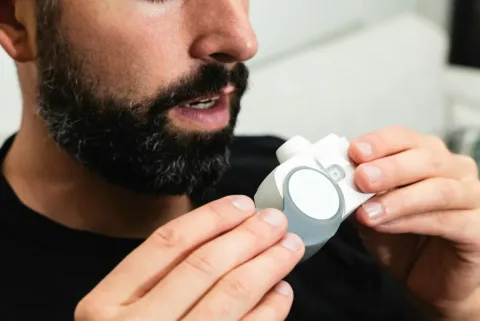
E-cigarette aerosol is different: no combustion, but the heated liquid produces an aerosol of propylene glycol, glycerin, nicotine, flavorings, and trace metals. Czoli et al. documented the composition. The particle size distribution is skewed toward ultrafines, which the SEN66 captures in PM1.0 but cannot count individually. The health profile is still under active investigation; CDC maintains current guidance.
In the dashboard, any of these reads as a sharp PM2.5 spike (50-300+ µg/m³ during a session, depending on room size and ventilation) with a brief VOC accompaniment and rapid decay if the room is ventilated. The ultrafine-heavy signature of vape aerosol is subtle, but persistent vaping shifts the PM1.0/PM2.5 ratio toward the lower end. Thirdhand residue (particles deposited on surfaces) keeps emitting trace VOCs after smoking ends, the source of "smoker's home" smell.
If household members smoke or vape: keep it outdoors, run HEPA filtration in adjacent rooms, ventilate aggressively after sessions, and avoid burning in any room a child or asthmatic uses regularly.
References
- U.S. Surgeon General - Secondhand smoke (2006) www.surgeongeneral.gov
- CDC - About e-cigarettes www.cdc.gov
- Czoli et al. - E-cigarette aerosol composition doi.org
- CDC / Surgeon General - Thirdhand smoke www.cdc.gov