
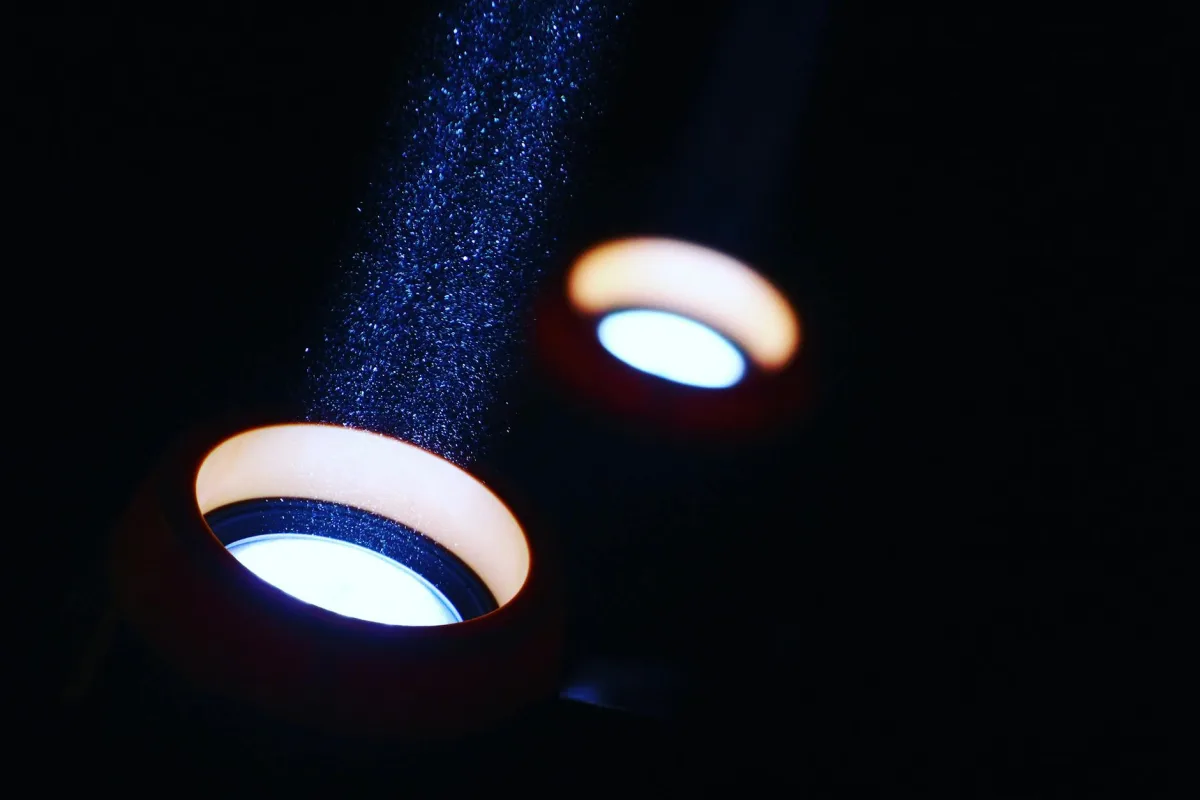
Ultrafine particles (UFP) are particles smaller than 0.1 micrometers (100 nanometers), smaller than most viruses. They form in any high-temperature process: combustion engines, gas stoves, candles, laser printers, 3D printers, lithium fires. Because they are so small, they behave more like gas than like dust: they diffuse through air slowly, they don't settle, and they cross from alveoli into the bloodstream within minutes.
Most consumer PM sensors, including the optical-scattering instrument in the SEN66, have a hard time below ~0.3 µm. Their physics relies on photons scattering off particles, and below the wavelength of light the cross-section collapses. So the SEN66 reports PM1.0, PM2.5, PM4.0, and PM10, but everything below ~0.3 µm gets bundled into the PM1.0 figure. The ultrafines are present in that number, but we cannot count them individually.
Why it matters: a growing literature (Oberdörster et al., and a long tail since) shows that for the same mass concentration, ultrafines carry more health risk than larger particles, more surface area per gram, more reactive chemistry, more efficient delivery into tissues. They are the dominant fraction in fresh diesel exhaust, fresh wildfire smoke, and the air immediately above a gas stovetop.
For everyday interpretation: when PM1.0 spikes faster than PM2.5, you are looking at a fresh-combustion event with a high ultrafine fraction. As that plume ages over minutes to hours, particles agglomerate, the UFP fraction drops, and the PM2.5 reading rises in lockstep. The interventions are the same as PM2.5 (HEPA filtration, source elimination), but the timing matters: ultrafines do most of their damage in the first 20 minutes.
This is environmental information, not medical advice. The dashboard's readings help you make decisions about the air in your space. They do not diagnose conditions, interpret symptoms, or replace conversations with your physician. If symptoms persist, worsen, or coincide with a known exposure, talk to a healthcare professional. See the AI's medical-advice scope.