
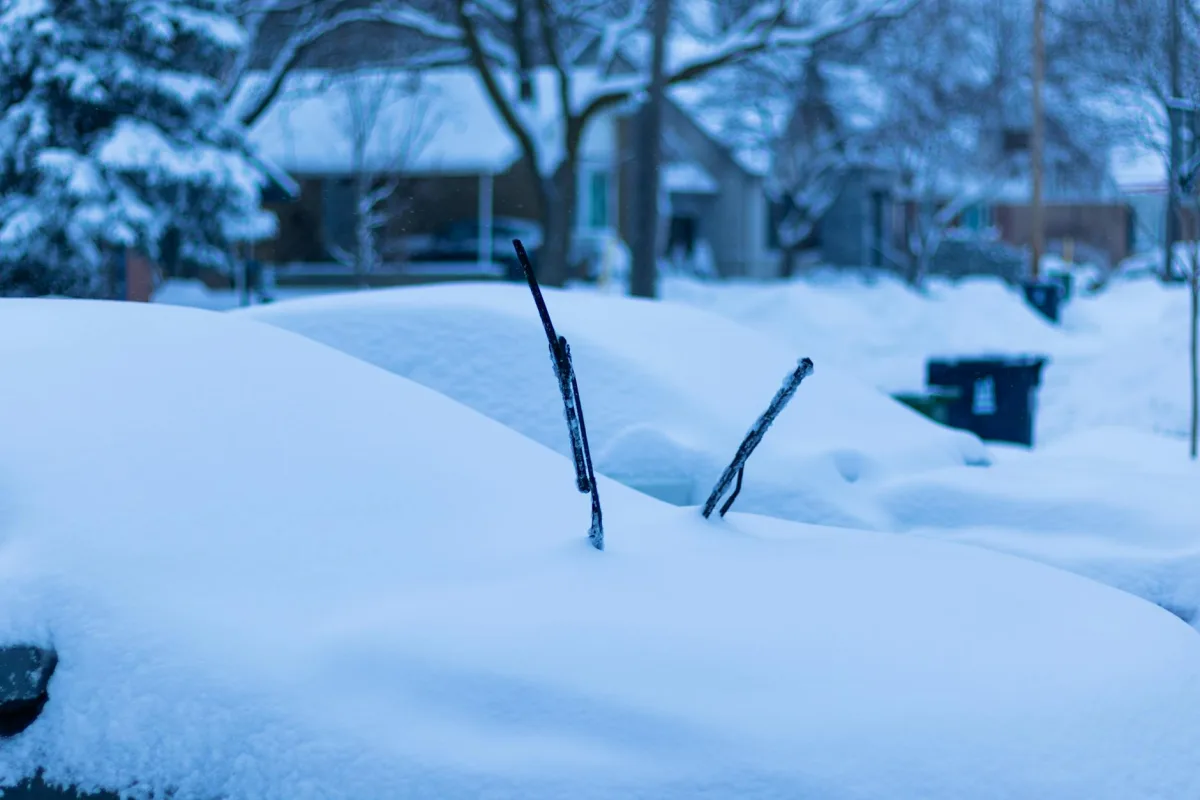
Snow affects outdoor air quality in two opposing ways. Active snowfall scavenges particles from the air similar to rain (see precipitation and air quality), often producing a 30 to 70% PM2.5 reduction during the snowfall. Andronache documents the scavenging coefficients; falling snow is a strong air-quality cleanup. After the snowfall, the air below the freshly cleaned column is usually clearer than before.
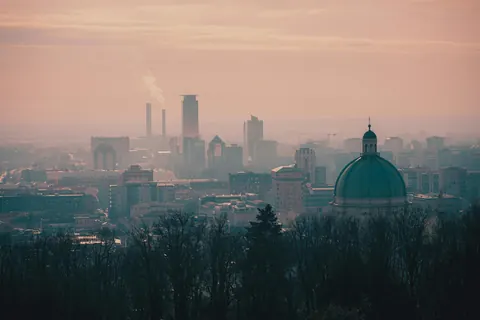
Persistent snow cover does the opposite. A snow-covered surface reflects 80 to 90% of solar radiation (high albedo); the air immediately above stays cold while air higher up warms; the resulting temperature inversion traps emissions near the ground. NOAA documents the meteorology. Cities in mountain basins (Salt Lake City, Calgary, Denver) experience some of their worst PM2.5 exposure during multi-day winter inversions over snow.
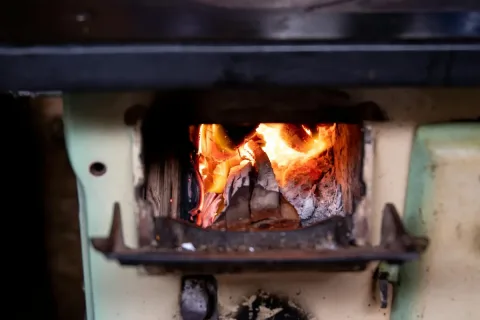
For households with wood-burning, this is the canonical "wood smoke trapped in the valley" pattern. The combination of snow-covered ground, clear cold nights, and active wood stoves can produce outdoor PM2.5 levels in the 100s of µg/m³ in moderate-sized cities. See wood stoves and fireplaces. The interpretation layer reads snow depth as one input to inversion-risk prediction in cold zones.
Indoor implications: snow depth correlates with reduced infiltration (envelope sealing is more effective when outdoor wind is calm under inversion conditions), so indoor pollutants from internal sources persist longer when snow is on the ground. The dashboard's winter-mode threshold for ventilation suggestion is more sensitive in zones 6-8 with snow depth above 10 cm.
References
- NOAA NWS - Temperature inversions www.weather.gov
- EPA - Wood smoke and your health www.epa.gov
- Open-Meteo - Forecast API documentation open-meteo.com
- Andronache - Aerosol scavenging by rain (J. Geophys. Res.) doi.org