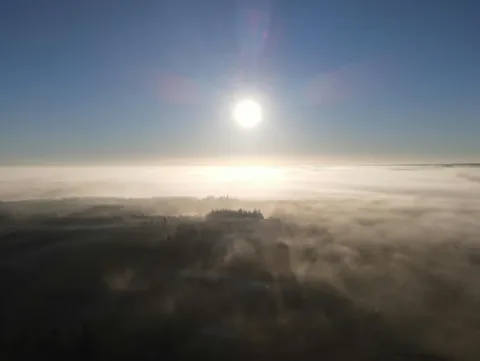


Ground-level ozone is not emitted directly; it is produced photochemically from precursor gases (NOx and VOCs) in the presence of sunlight. The amount of ozone produced on any given day depends strongly on how much UV radiation reaches the surface, which depends in turn on cloud cover. Daniel Jacob's "Introduction to Atmospheric Chemistry" is the standard reference for the underlying physics.
The dependence is substantial. A fully overcast day reduces ground-level UV by 50 to 90% compared to clear sky, depending on cloud type and thickness. The reaction rates that produce ozone scale roughly linearly with UV; the integrated effect across a day with persistent cloud cover is meaningfully lower ozone than the same day clear. NWS ozone forecasts incorporate cloud-cover predictions; so does the outdoor air-quality forecast model.
For Terrestream users, tomorrow's cloud forecast is a useful predictor of tomorrow's outdoor ozone. A sunny forecast in late spring through early fall is the canonical "ozone alert" setup, especially in urban areas with high NOx background. An overcast forecast means ozone will be low even in a typically ozone-prone area. The interpretation layer reads cloud cover and adjusts the next-day ventilation recommendation accordingly.
Cloud cover also affects indoor parameters. Lower outdoor UV during cloudy weather means lower indoor circadian-relevant lux from windows; the dashboard's lux interpretation accounts for cloud cover when comparing daily light totals against the WHO 1,000-lux daytime threshold for circadian regulation. See lux, UV index, and solar radiation and air chemistry.
References
- EPA - Ground-level ozone basics www.epa.gov
- Jacob - Introduction to Atmospheric Chemistry (Harvard) acmg.seas.harvard.edu
- Open-Meteo - Forecast API documentation open-meteo.com
- NOAA NWS - Clouds reference www.weather.gov