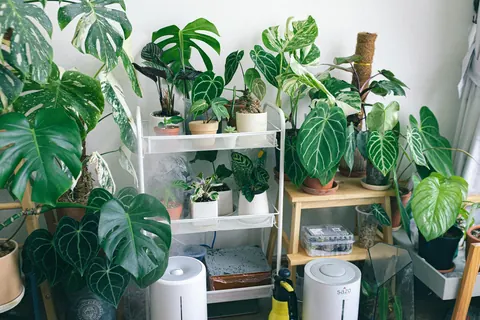

The NASA Clean Air Study (Wolverton 1989) tested houseplants in sealed 0.88 m³ chambers and found measurable removal of benzene, formaldehyde, and trichloroethylene over 24-48 hours. The study was designed for closed-loop life support (a future Mars mission or space station). The widely shared "houseplants clean indoor air" claim treats those chamber results as if they applied to ordinary rooms. They do not.
The math is unkind. Cummings and Waring 2019 recalculated the same data in terms of clean-air-delivery rate (CADR), the unit used to compare air cleaners. A single houseplant in an average-sized room contributes a CADR roughly equivalent to 0.02 cfm. A $50 HEPA purifier contributes 100-200 cfm. To match the HEPA, you would need 5,000-10,000 houseplants in the room. Stacked floor-to-ceiling, they would fill most of the volume that air actually occupies.
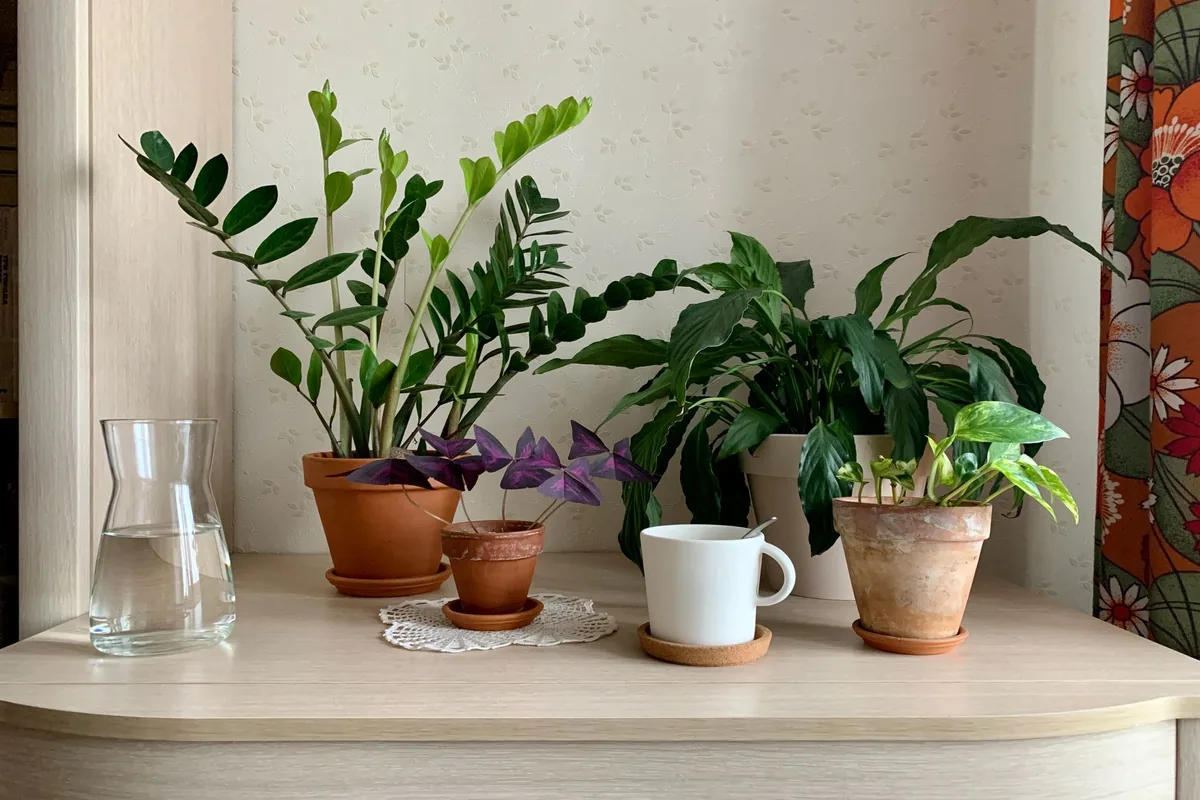
What plants do contribute: a small amount of humidity (transpiration), some psychological benefit, and some indirect IAQ improvement through reduced stress and connection to natural systems. None of these are bad reasons to keep houseplants. They are bad reasons to skip the HEPA. The dashboard's PM2.5 and VOC index traces in a heavily planted room will be statistically indistinguishable from a similar plant-free room of the same volume and ventilation rate.
Two caveats. Heavily overwatered plants can be a mold source (potting-soil microbiome). Some plants (lilies, dieffenbachia) are toxic to pets if chewed. These are the practical IAQ issues with houseplants, and neither is about air purification. For genuine IAQ improvement see HEPA and CADR and ventilation on demand.
References
- Wolverton (NASA) - Clean Air Study (1989) ntrs.nasa.gov
- Cummings & Waring - Potted plants and indoor VOC removal doi.org
- EPA - Improving indoor air quality (plants) www.epa.gov
- Wolverton et al. - NASA Clean Air Study report ntrs.nasa.gov