
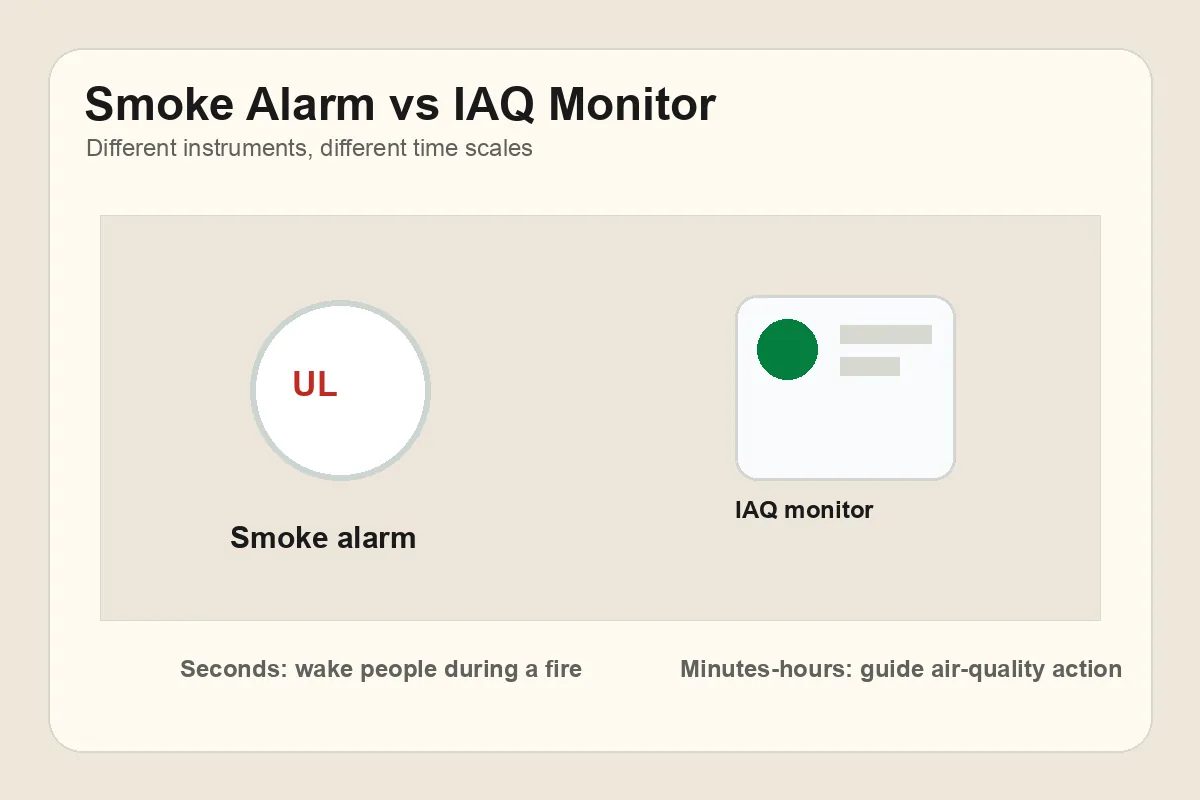
A UL 217 listed smoke alarm exists for one purpose: to wake you up and get you out of the building during a fire. The certification standard specifies how fast the device must respond to specific smoke profiles, how loud the horn must be (85 dBA at 10 feet, in the T-3 temporal pattern that NFPA 72 requires for fire), how the unit behaves on low battery, and how it integrates with interconnected alarms in the rest of the home. The United States Fire Administration and NFPA fire-safety guidance are unambiguous: every level of the home and every sleeping area needs one, interconnected if at all possible, replaced every 10 years.
The detection technology is fundamentally different. A smoke alarm uses one of two physical methods: ionization, which passes a small current through a chamber of air ionized by a tiny americium-241 source and watches for the current to drop when smoke particles disrupt the ions (faster on flaming fires); or photoelectric, which shines a light beam across a chamber and watches for scattered light when smoke enters (faster on smoldering fires). The Terrestream PM channel is a laser-scattering particle counter, similar physics to the photoelectric chamber but optimized for size resolution and steady-state mass concentration, not for the seconds-scale rise that signals an active fire. The SEN66 reports rolling-minute averages with light digital smoothing; that smoothing is the right answer for IAQ characterization and the wrong answer for life-safety alarming.
The alarm modality is the other half of the gap. A UL 217 smoke alarm wakes you up at 3 AM through a closed bedroom door with an 85 dBA horn; that is loud enough to penetrate sleep reliably across the age range, and the T-3 pattern is specifically tuned for that. The Terrestream IAQ monitor is silent by default and sends a phone push notification when PM2.5 climbs; phone notifications do not wake people through sleep and are not designed to. The dashboard also reports things hours after they happened, in trend form, which is the correct behavior for "your cooking generated PM" but the wrong behavior for "your house is on fire right now." Placement reflects the same divergence: smoke alarms go on the ceiling (smoke rises) per NFPA 72; IAQ monitors go at breathing height wherever you actually want to characterize the air.
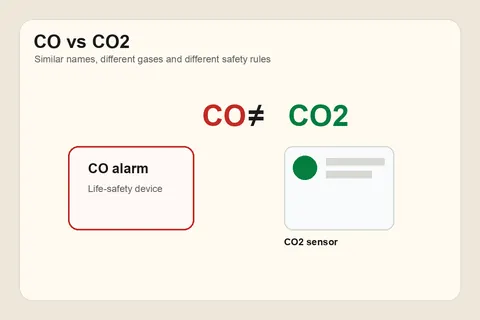
The correct mental model is that you need both, and neither is optional. The smoke alarm is non-negotiable code-required life-safety equipment whose only job is keeping you alive during a fire. The IAQ monitor is decision-support hardware for the other 99.99% of the year when there is no fire and you want to understand the air you are actually breathing. The Terrestream device characterizes wildfire-smoke infiltration over hours and days; the smoke alarm tells you that the smoke is now coming from inside the house. See smoke and fire detection for the broader life-safety equipment list, CO vs CO2 for the parallel disambiguation on combustion gases, and what the sensor cannot warn you about for the full inventory of life-safety scope gaps.
Reminder: Terrestream is not a life-safety device. It is not a carbon-monoxide alarm, not a smoke alarm, not a combustible-gas detector, not a radon monitor. The readings here characterize chronic and acute air quality for decisions and trends; they do not replace UL-listed dedicated alarms or professional testing. See what the sensor cannot warn you about.
References
- UL 217 - Smoke alarms www.shopulstandards.com
- NFPA 72 - National Fire Alarm and Signaling Code www.nfpa.org
- NFPA - Smoke alarms facts www.nfpa.org
- USFA - Home fire safety www.usfa.fema.gov