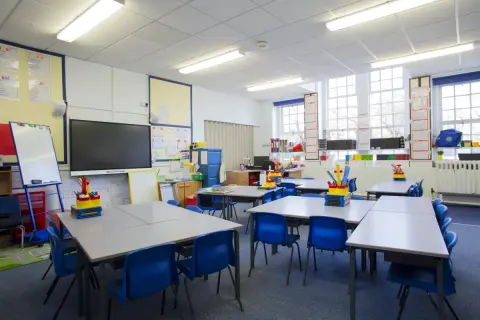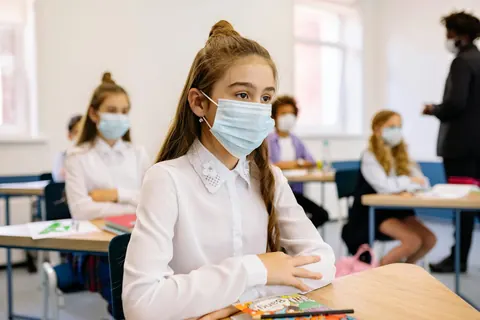


A typical school-aged child spends 35-40 hours a week inside school buildings, often more time than any single occupant spends in a typical office. The IAQ in those buildings ranges from excellent (newer construction with mechanical ventilation, MERV-13 filtration, monitored CO2) to genuinely bad (1960s-1980s buildings with operable-window-only ventilation, deferred maintenance, and uncontrolled humidity). The EPA IAQ Tools for Schools program quantifies the problem and provides a framework; most US schools have not adopted it. See EPA Tools for Schools for the program details.
Classroom CO2 is the headline. ASHRAE 62.1 specifies 10 cfm/person of outside air for K-12 classrooms (15 cfm/person for high school chemistry labs), which is calibrated to keep CO2 near 1,000 ppm at design occupancy. Harvard's Schools for Health recommends 800 ppm as a learning target based on the cognitive literature. Measured reality in many schools: 1,200-1,800 ppm by the last period of the day in non-ventilated rooms with the door closed. The classroom-CO₂-and-learning literature connects these levels to measurable drops in attention, decision-making, and test performance.
Other problem spots in a school. Gymnasiums and locker rooms see VOC peaks from cleaning chemicals (gym mats, locker disinfectants) plus body-odor compounds plus PM10 from synthetic-floor abrasion. Cafeterias add cooking PM2.5 and NOx if the kitchen ventilation undersizes the load. Older buildings (especially in humid climates or with flat roofs that have leaked) carry mold loads in walls and HVAC ductwork, see mold spores. School-bus diesel idling near the building intake is a documented PM and ultrafine-particle source; many districts now have anti-idling policies on paper that are routinely violated in practice. CDC Healthy Schools data underlines the children-specific stakes.
What works: MERV-13 filtration on supply air, portable HEPA in classrooms sized per CADR, a CO2 monitor in each classroom with a 1,000 ppm threshold, a demand-controlled ventilation strategy that opens the outside-air damper when CO2 rises (see DCV), and aggressive moisture management to prevent mold. The framework for advocating these is state IAQ-in-schools legislation (active in CT, NY, NJ, ME, and others), parent-teacher-association reporting, and direct conversations with district facilities staff. For acute events see school wildfire response; for the population side see children and air quality.
References
- EPA - IAQ Tools for Schools www.epa.gov
- ASHRAE Standard 62.1 - Ventilation for Acceptable Indoor Air Quality www.ashrae.org
- CDC - Healthy Schools www.cdc.gov
- Harvard - Schools for Health schools.forhealth.org