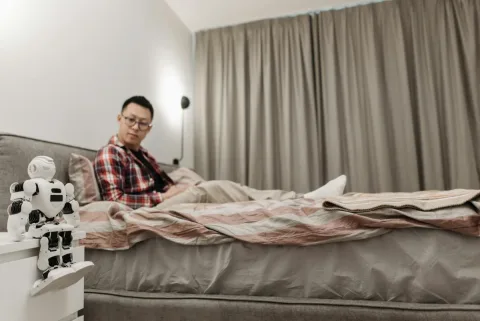


A "rebreathing room" is one where ventilation is so much slower than the rate at which occupants exhale CO2 that the gas accumulates faster than outdoor air can dilute it. The signature on the dashboard is unmistakable: CO2 climbs at a near-linear rate proportional to occupancy density, and it does not decay back to baseline because the ventilation pathway is too small to clear it. A room that simply has elevated CO2 from the outdoors looks different. A room that is rebreathing its own air has a sawtooth pattern locked to occupancy.
The math is concrete. A resting adult exhales roughly 20 L of CO2 per hour (this number comes from LBNL studies by Persily and colleagues, and is reasonably stable across body size and resting metabolism). In a closed 30 m3 bedroom (typical small to medium bedroom), one occupant adds ~660 ppm per hour to ambient; two occupants add ~1,300 ppm/hr; a closed bedroom door cuts the achievable ventilation rate to perhaps 0.2 air changes per hour, far below what is needed to keep up. Six hours in becomes 1,800-2,400 ppm by morning, which is exactly what most overnight bedroom traces show.
The way to distinguish rebreathing from "outdoor CO2 elevated" is the decay test. Leave the room, open the door wide, ventilate it for fifteen minutes, then return. A rebreathing room will fall back to 500-700 ppm during the airing-out (because the room itself was the source) and start climbing again as soon as occupants return. An outdoor-elevated room stays elevated regardless of door state because the elevation is coming from outside. The dashboard's sparkline view is the right tool for spotting this: look for the rapid drop on door-open events.
Why CO2 matters as a ventilation proxy: in occupied indoor spaces, CO2 is the cleanest single measurement of "are people getting enough outside air". ASHRAE 62.1 sets ventilation rates that, when met, keep most occupied rooms below 1,000 ppm. Health Canada uses 1,000 ppm as the long-term residential guideline. The dashboard surfaces a rebreathing-notification pattern when the slope is steady, the magnitude is occupancy-consistent, and the decay test fails. See bedroom overnight and reducing CO2 for the mitigation playbook.
References
- ASHRAE Standard 62.1 - Ventilation for Acceptable Indoor Air Quality www.ashrae.org
- Persily (LBNL) - Indoor CO₂ and ventilation buildings.lbl.gov
- Allen et al. - COGfx ventilation and cognition study doi.org
- Health Canada - Residential CO₂ guideline www.canada.ca