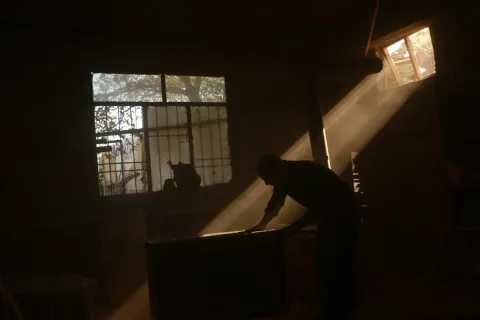

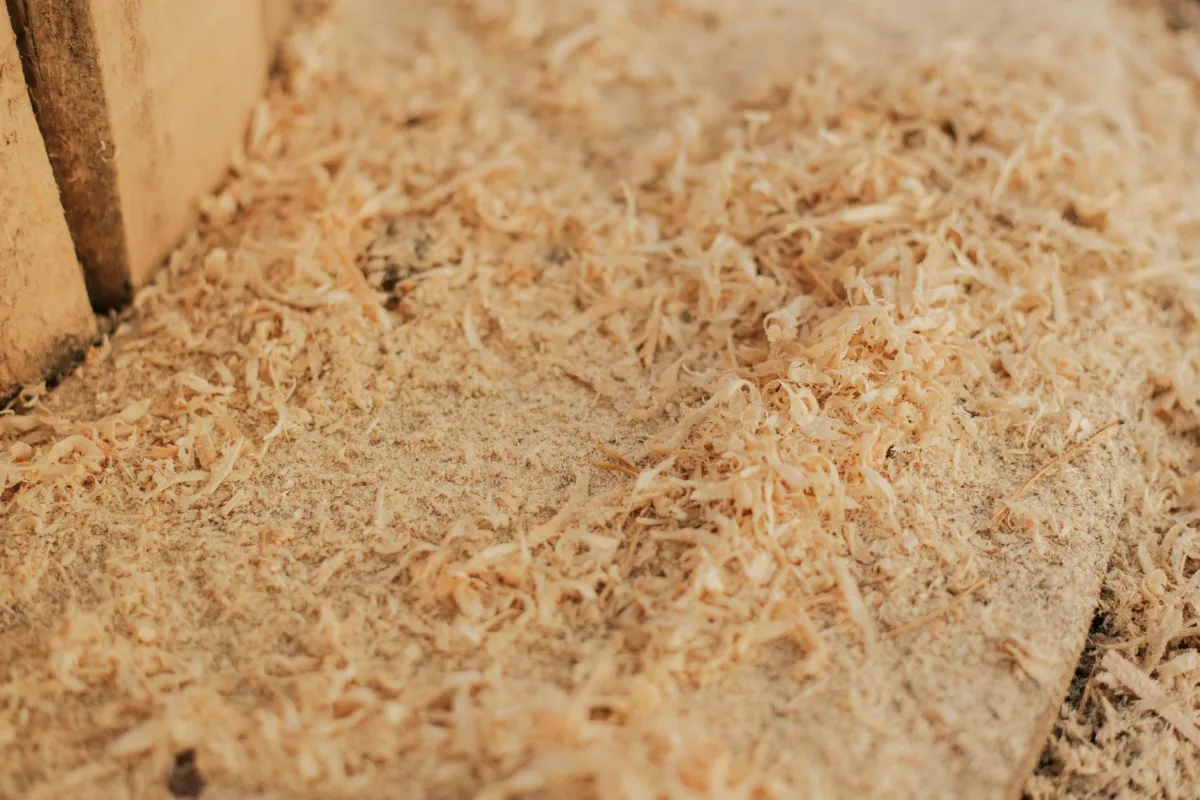
A hobby woodworking shop generates two distinct air-quality loads: sawdust from cutting, planing, sanding, and routing, and VOCs from finishes and adhesives. The dust load is the bigger health story. IARC Monograph 100C classifies wood dust as a Group 1 human carcinogen, with the strongest evidence for nasopharyngeal cancer in long-term occupational woodworkers and weaker but consistent evidence for sinonasal and laryngeal cancers. The risk is species-dependent: hardwoods (oak, beech, walnut, mahogany) carry stronger evidence than softwoods, and a handful of species (Western red cedar in particular) cause respiratory sensitization on top of the cancer risk. The hobby exposure is much lower than the occupational baseline that drove the classification, but the chemistry is the same.
On the dashboard the dust load shows up as a sharp PM10 spike during the operation, a slower-decaying PM2.5 tail (fine particles stay airborne longer), and an extended period of elevated readings as settled dust gets re-suspended whenever someone moves in the shop. Sanding is the worst offender by particle count, because it produces the most particles in the respirable PM2.5 and PM1 size range; rough cutting throws bigger particles that settle faster. A shop with no dust collection running a belt sander on oak will push PM2.5 past 500 µg/m³ within minutes. Long-term, NIOSH and OSHA set workplace permissible exposure limits at 5 mg/m³ for most species and 1 mg/m³ for Western red cedar; hobby shops are not bound by those numbers but they are the calibration point for "this is a level a body has shown harm at."
Finishes carry the second load. Oil finishes (boiled linseed, tung, hardwax-oil) emit modest VOCs that taper within a few days. Solvent-based polyurethane, lacquer, shellac, and contact cement emit aggressively for hours during application and continue at lower levels for days; the VOC index on the dashboard will sit at 200+ during a polyurethane wipe-on and will not return to baseline until well into the next day. Water-based polyurethane and water-based lacquer are dramatically cleaner than their solvent equivalents and the dashboard will show that. Wood glues (PVA yellow glue, polyurethane glue, epoxy) are short-duration VOC events that clear quickly. Formaldehyde from MDF, plywood, and particleboard cuts is a separate slow-release problem covered in the formaldehyde detail article.
Controls that actually work, from highest leverage to lowest: dust collection at the tool (a 4-inch port on every machine connected to a cyclone separator and a HEPA-class collector cuts respirable dust by 90% or more); ambient air cleaner in the shop (ceiling-hung unit with HEPA at 800 CFM, or a HEPA room purifier sized for the volume); downdraft sanding table for hand-sanding work; respirator (P100 or N95 fit-tested) for any operation generating fine dust, particularly with Western red cedar or hardwoods; ventilation during finishing (a window fan exhausting to outside drops the in-shop VOC level to ambient within minutes). A shop with the first three of those running can reduce PM2.5 at the woodworker's breathing zone by 95% versus an uncontrolled shop, and the dashboard will confirm it.
This is environmental information, not medical advice. The dashboard's readings help you make decisions about the air in your space. They do not diagnose conditions, interpret symptoms, or replace conversations with your physician. If symptoms persist, worsen, or coincide with a known exposure, talk to a healthcare professional. See the AI's medical-advice scope.
References
- IARC - Wood dust classification monographs.iarc.who.int
- CDC NIOSH - Wood dust www.cdc.gov
- OSHA - Wood dust www.osha.gov
- EPA - Indoor air quality (woodworking) www.epa.gov