
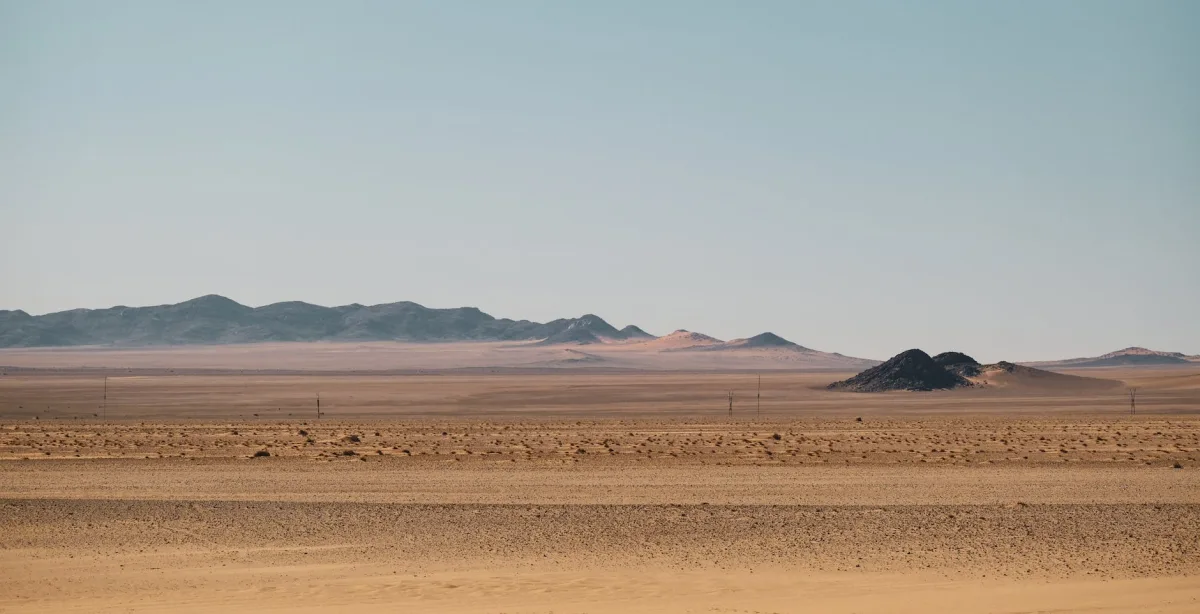
Mineral dust is the second-largest aerosol category by mass globally (after sea salt), and the largest one most people will encounter as a discrete event. Major sources: the Sahara desert in northern Africa, the Taklamakan and Gobi deserts in central Asia, the southwestern U.S., and Australia. Prospero et al. remains the standard reference.
For North American users, two recurring patterns matter. Saharan dust crosses the tropical Atlantic on the trade winds from June through August, regularly reaching the Caribbean, the Gulf Coast, and as far north as Texas. NOAA tracks the major plumes. Asian dust crosses the Pacific in spring (March to May), reaching the Pacific Northwest and sometimes farther east; less consistent but capable of large events.
Mineral dust differs from wildfire smoke chemically. The particles are predominantly silicate minerals (kaolinite, illite, quartz), not organic combustion byproducts. The size distribution is skewed coarser (most mass in PM10, less in PM2.5) than wildfire smoke (which is PM2.5-dominant). On the sensor, a dust event shows as elevated PM10 with a high coarse fraction and normal VOC; a smoke event shows PM2.5-dominant with elevated VOC.
Health effects are similar in many ways (respiratory irritation, asthma exacerbation, cardiovascular impact at high exposures) but iron-rich dust particles also act as long-range nutrient sources for ocean phytoplankton, which is biologically interesting if not health-relevant. The intervention is identical to wildfire: close windows, run HEPA. Open-Meteo's air-quality API includes a dust field that surfaces these events as they occur.
References
- NOAA - Saharan dust events oceanservice.noaa.gov
- Prospero et al. - Environmental characterization of global dust doi.org
- Open-Meteo - Air Quality API documentation open-meteo.com
- WHO Global Air Quality Guidelines (2021) www.who.int