Terrestream for business

Air quality data for every site you run.

Twelve signals from one premium sensor. A live dashboard across every building, floor, and zone. Named outdoor data. Local-first integrations with no cloud lock-in. Built for facilities, EHS, workplace, and ESG teams.

Talk to sales See the platform

4,699 MXN one-time hardware. A real free tier. Per-sensor fleet pricing when you scale.

Contexto de despliegue en México Precios en MXN con envío a México, documentos regulatorios e impuestos aplicables calculados al pagar.

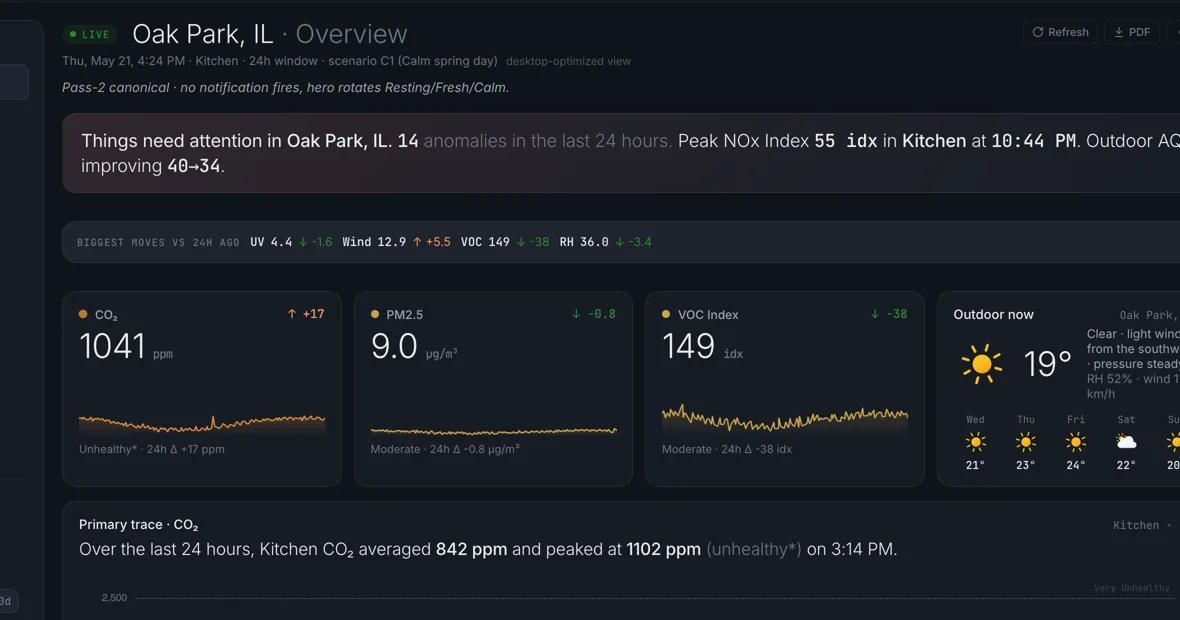
Terrestream dashboard showing live air-quality readings across multiple rooms.

Built for the teams accountable for indoor air

Designed for facilities, EHS, workplace, and ESG.

Why buildings standardize on Terrestream

Three advantages competitors do not publish.

Radical source transparency.

Every signal traces to a named premium component with a public datasheet. The core is the Sensirion SEN66. Bosch BMP390L adds pressure context. Texas Instruments OPT3001 adds visible-light context. We publish the datasheets and the calibration certificate.

See the measurement evidence

No lock-in, local-first.

The sensor runs offline. A local HTTP API and MQTT feed your BMS directly, with Home Assistant for local automation and Matter-compatible ecosystems bridged through Home Assistant. Export everything as CSV, API, or PDF. Nothing is trapped behind our cloud.

Outdoor context, cited.

Indoor readings are set against named authoritative streams: Open-Meteo, Google Air Quality (US EPA AQI), Google Pollen, and NOAA HMS with NASA FIRMS for wildfire smoke. You see indoor versus outdoor, not a number in a vacuum.

See the named sources

The fleet plane

Manage one room or a thousand from one account.

Organize sensors by building, floor, and zone. Assign roles for the account administrator, viewers, and installers. Route alerts to SMS, email, a webhook, or your ticketing system, configured per zone and silenced outside operating hours by default.

  • Building, floor, and zone hierarchy
  • Roles: administrator, viewer, installer
  • Routed alerts: SMS, email, webhook, ticketing
  • CSV, API, and PDF exports
See the live dashboard
Fleet dashboard rolling up air-quality readings across rooms and floors.

Evidence, not adjectives

We publish the math.

Pick a scenario. The same signals tell a different story for a meeting room, a kitchen, a filtration cycle, or outdoor infiltration. Live charts, sourced to the datasheet.

C(t) = Cout + (C0 − Cout)e−ACH·t

CO2 decays toward the outdoor baseline at a rate set by air changes per hour. Watch the slope and you can tell whether a room recovers after occupancy or needs a schedule, a damper, or a use-pattern change.

Sourced to the Sensirion SEN66 datasheet and the calibration certificate.

See the full evidence, ten charts and the standards map
CO2 buildup and ventilation decay.
VOC and NOx event fingerprint, by scenario.

Trust and data ownership

Precise about what is true today.

Security and ownership

  • Local-first operation. Readings and alerts continue on your network during a cloud outage.
  • Customer data is processed on United States infrastructure.
  • TLS 1.2 or higher in transit. AES-256 at rest.
  • Role-based access with multi-factor authentication for administrators.
  • Periodic penetration testing, intrusion detection, and a secure development lifecycle.
  • Full export as CSV, API, or PDF. Your data stays yours.

SOC 2 Type II is in progress. The TOM summary, a completed security questionnaire, and an executed DPA are available on request under NDA. Single sign-on is on the roadmap.

Standards, the honest line

The sensor measures the parameters that RESET, WELL, and Title 24 monitoring workflows depend on. We map our signals to those frameworks and provide the exports and source links your consultant needs.

It is not an accredited reference monitor for a certification submission. The device holds no device-level accreditation, and we say so plainly. Use it for operational monitoring, trend detection, and fleet visibility, and pair it with an accredited monitor where a submission requires one.

WELL and RESET workflows

Built for monitoring work, precise about accreditation.

Terrestream supports the operational monitoring workflows behind WELL Performance Monitoring and RESET projects. It is not an accredited reference monitor for certification submissions.

Map

Match CO2, PM, TVOC-index context, temperature, and humidity signals to the WELL and RESET monitoring workflows your consultant is using.

Monitor

Trend rooms, zones, and floors continuously, then spot persistent out-of-band spaces before a sampling visit or occupant complaint.

Export

Share CSV, API, scheduled PDF, source links, and the accreditation boundary statement with the project team.

For submissions that require an accredited reference instrument, pair Terrestream with that monitor and use Terrestream for continuous operations, trend detection, and fleet visibility.

Transparent pricing

One hardware price. Pay for scale only when you need it.

4,699 MXN once per sensor, the same price consumers pay. A real free tier with no subscription floor. Business plans start at 149 MXN per sensor per month with volume discounts. No hub to buy.

Free

$0

No subscription floor. The basics on every connected sensor.

Volume

Talk to sales

Large portfolios, scoped deployment, and a tailored quote.

Annual billing saves about two months. See the full pricing and plan comparison

Budget model

Estimate monitoring cost before you talk to anyone.

Use this as a procurement starting point. Hardware and subscription math come from the public pricing tiers. The planning band is an internal occupant-time assumption, not a published savings coefficient, and should be replaced with your own finance assumptions.

Research context: productivity and air quality, including Satish/LBNL, Harvard COGfx, Fisk ventilation reviews, and Allen Healthy Buildings references already cited there. Those sources explain why indoor air can matter; they do not certify the calculator's planning band.

Hardware 140,970 MXN 4,699 MXN once per sensor
Business plan 3,270 MXN/mo 109 MXN per sensor per month
Year-one monitoring cost 173,670 MXN Hardware plus annual billing
Internal planning lens $97,500-$292,500 0.25%-0.75% internal assumption

Office preset: $65,000 annual value per occupant. Planning range uses 0.25%-0.75% as an internal assumption, not a cited or guaranteed savings claim.

Email me this estimate Scope with sales

Business comparison

A building sensor should not become another silo.

The commercial difference is less about one reading and more about exportability, local integration, and the evidence trail your facilities and security teams can inspect.

Terrestream 4,699 MXN hardware Premium monitors varies by model Budget meters single-purpose
Indoor + outdoor fusion Weather, AQI, pollen, smoke Usually indoor-only Sensor-dependent
No-subscription device floor Standalone display + local flows Often cloud-led Usually device-only
Local / BMS path Local HTTP API, MQTT, Home Assistant Varies by vendor or tier Rare
Published evidence Datasheets, calibration certificate, evidence page Product sheets vary Sparse
Commercial exports CSV, API, scheduled PDF Usually plan-dependent Rare

See the full monitor comparison

Procurement-friendly

Public links for the vendor review packet.

Before you standardize

Questions buildings ask.

Does it run without your cloud?

Yes. The sensor operates standalone offline, and a local HTTP API plus MQTT keep readings and alerts flowing on your own network. The cloud dashboard is additive, not required.

What happens to our data if we leave?

You export it. Readings are available as CSV, API, or PDF at any time. There is no proprietary format holding your history hostage.

Do you have SOC 2 or single sign-on?

SOC 2 Type II is in progress. A TOM summary, a completed security questionnaire, and an executed DPA are available on request under NDA today. Single sign-on is on the Business roadmap; org accounts use roles with multi-factor authentication now.

How does fleet pricing work?

Hardware is 4,699 MXN once per sensor, the same price consumers pay. The Business plane starts at 149 MXN per sensor per month with volume discounts, and annual billing saves about two months. There is no hub to buy and no setup fee. Tell us your sensor count on the quote and we will price it.

How do we deploy and power sensors across a site?

Each sensor powers from USB-C using the included UL-listed 18 W adapter, so it runs from any standard outlet, a USB power source, or a USB power bank. For buildings standardized on Power over Ethernet, a PoE to USB-C adapter works. It connects over 2.4 GHz Wi-Fi (802.11 b/g/n) and talks to our cloud over outbound HTTPS only, with no inbound ports, so it sits comfortably on a segmented or guest VLAN. If the network drops, readings and alerts continue on the local API and MQTT until it reconnects. The sensor rests on any flat surface, with wall mounting coming soon. Each sensor claims to your organization account during setup, and our team provides installation guidance and tuning for larger fleets. Sensors carry a one-year limited warranty with 30-day returns.

Does it integrate with our building system?

Local HTTP API and MQTT connect to most BMS and automation stacks. Home Assistant covers the local automation layer, and Matter-compatible platforms are bridged through Home Assistant. Alerts route to SMS, email, webhook, or your ticketing system.

Can it support our WELL or RESET work?

It supports the monitoring workflows those programs depend on and gives your consultant the parameters, exports, and source links they need. It is not an accredited reference monitor for a certification submission. See the evidence page and our accreditation statement for the exact boundary.


Talk to sales

Tell us about your buildings. We will scope it with you.